
Welcome to our website about books that are set in or contain facts about Argyll. Here you can find a selection of history books, tourist guides, fairy tales, and novels that all focus on Argyll and its rich history.

About Argyll
Argyll (archaically: Argyle) is an ancient shire of western Scotland. The modern council area of Argyll and Bute is largely made up by the old Argyllshire + the island of Bute and the Helensburgh area. The Morvern and Ardnamurchan areas were included in the shire of Argyll but are now a part of the Highland council area.
Argyll is of ancient origin and has its roots in the ancient kingdom of Dál Riata. The name Argyll or Argyle comes from airer Goídel, which means “border region of the Gaels” or “coast of the Gaels” in Old Gaelic. During the medieval era, Argyll was a bishopric with its cathedral located at Lismore.
Argylls largest towns are Oban, Dunoon, and Campbeltown. Inveraray has been the county town of Argyll and is still the seat of the Duke of Argyll. From the 19th century, Lochgilphead was the seat of local government for the county of Argyll.
Clans
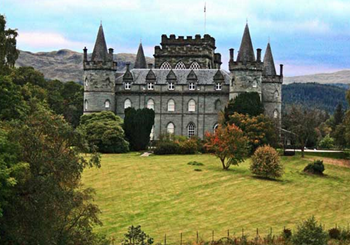
Historically, the Campbell clan was the main clan in this part of Scotland. This is the clan which hosted the long line of the Duke of Argyll. It should be noted however that until the early 1600s, the Gregor clan held a lot of land too.
The Lamont clan was alternately allied with the Campbells and fighting the Campbells, until the Dunoon massacre of 1646. The Lamont clan existed even after the massacre, but only in small numbers. In the 1800s, the clan chief sold his lands and migrated to Australia.
The MacLean clan is associated with the Isle of Mull and the Duart Castle.
The Duntrune Castle on the banks of Loch Crinan is the seat of the Malcom clan (also known as MacCallum).
Surnames
At the United Kingdom Census of 1881, this was the ten most common surnames in Argyll.
- Campbell
- McDonald
- Cameron
- McLean
- McMillan
- McIntyre
- McDougall
- McCallum
- McKinnon
- McArthur
Duart Castle
Duart Castle, located overlooking the Sound of Mull, stands as a testament to Scotland’s rich history. With its roots dating back to the 13th century, it has played a significant role in the narrative of the Scottish Highlands and the Isle of Mull.
Duart Castle was originally built in the 13th century and has been the seat and ancestral home of the Clan Maclean for over 400 years. Throughout its history, it has witnessed numerous battles, seiges, and captures, reflecting the turbulent history of Scotland. By the late 17th century, Duart Castle was abandoned and fell into ruin. It wasn’t until the early 20th century that Sir Fitzroy Maclean purchased the castle and undertook its restoration. Today, it stands restored to its former glory, welcoming visitors from around the world.

Investing.co.uk is a website that will help UK investors invest their money smarter. The website feature information about stocks, mutual funds and other low-risk investments, as well as different types of high-risk trading. Examples of types of trading that you can learn by visiting investing.co.uk include forex trading and CFD trading. Investing.co.uk feature a large selection of broker reviews that you can use if you want to find a good FCA-regulated broker or a broker regulated by another major European regulatory body such as ESMA or CySec. If you want to a second opinion to make sure that you choose the best possible broker, then I recommend that you visit Daytrading.com’s broker guide.
The famous Argyle pattern
An argyle pattern consists of diamonds or lozenges. Most Argyle patterns contain layers of overlapping motifs, especially an overlay of intercrossing diagonal lines on solid diamonds.
It is known as argyle due to its connection to the Clan Campbell, who traditionally wore kilts and plaids sporting this pattern.
Socks featuring a tartan pattern has been worn by Scottish Highlanders since at least the 17th century.
In the 1920s, argyle knitwear became trendy throughout Great Britain and its popularity quickly spread to the United States as well. In knitting patterns, the intarsia technique was typically employed to achieve the argyle pattern. A driving force in this trend was Pringle of Scotland, who marketed their characteristic Pringle argyle design. The argyle pattern eventually became strongly associated with golf, partly thanks to the Duke of Windsor (in office 1937-1972) who wore jerseys and long socks sporting the pattern when on the golf course.